
Home » research
Category Archives: research
Lab visit by Rafael Bernardi
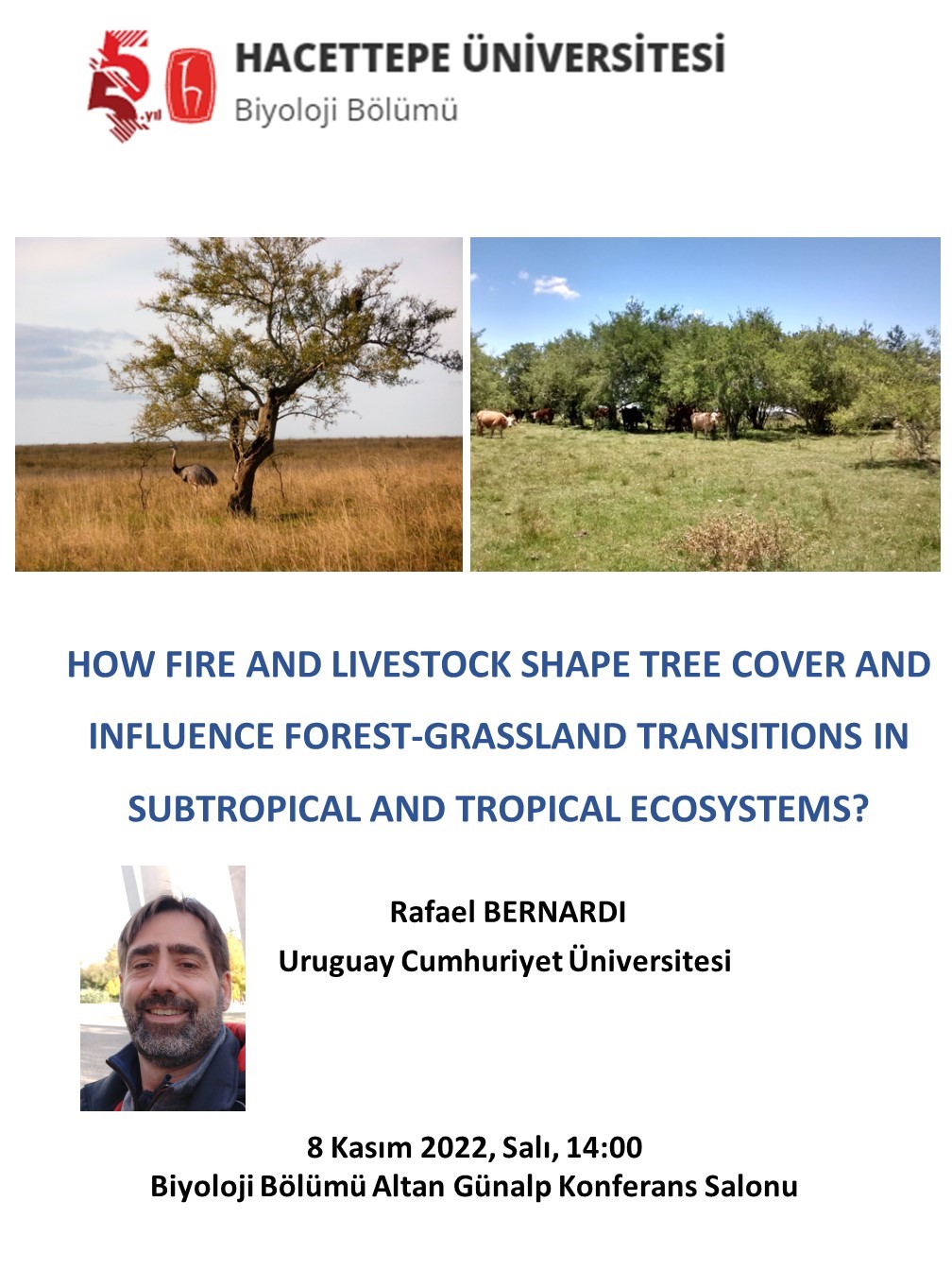
Last month, our lab had the pleasure of hosting Rafael Bernardi, a researcher from Uruguay. Rafael’s visit was an exciting and enriching experience for all of us, providing numerous opportunities to discuss projects, research papers, and potential new collaborations.
During his visit, Rafael delivered an insightful seminar on the impacts of fire and grazing on tropical forests and grasslands. This seminar, titled “How fire and livestock shape tree cover and influence forest-grassland transitions in subtropical and tropical ecosystems,” was held on November 8, 2022, at the Beytepe Campus of Hacettepe University. It attracted a significant audience and generated considerable interest.
In addition to the seminar, Rafael actively participated in our lab activities. He joined our discussions on various research topics and offered valuable feedback on our current projects. Specifically, during field trips and discussions in the laboratory meetings, we had opportunities to develop a project regarding the drivers of woody vegetation in Central Anatolia, which we have already started to work on.
We anticipate more opportunities to collaborate on new projects to enhance our understanding of the drivers of woody cover in various ecosystems.
New paper: Multiple fire-related cues stimulate germination in Chaenorhinum rubrifolium (Plantaginaceae), a rare annual in the Mediterranean Basin
Our paper on fire-related germination in a rare annual plant species in Turkey has been published in Seed Science Research: [Tavşanoğlu, Ç., Ergan, G., Çatav, Ş.S., Zare, G., Küçükakyüz, K., Özüdoğru, B. (2017) Multiple fire-related cues stimulate germination in Chaenorhinum rubrifolium (Plantaginaceae), a rare annual in the Mediterranean Basin. Seed Science Research. doi:10.1017/S0960258516000283]. In this paper, we examined the effect of several fire-related cues (including heat shocks, smoke, and chemicals found in smoke) on the germination of Chaenorhinum rubrifolium, a rare Mediterranean annual.
The species was only found in a restricted area in a recently burned site in Ören, Muğla, Turkey, and this is the first record of this species for Turkish flora. This record will be a subject of a separate taxonomic paper (Zare et al., submitted). Our findings on the germination behavior of the species in relation to fire also support this field observation.
Among the fire-related cues that were tested in the study, smoke solutions, nitrate, karrikinolide (a compound found in smoke), and mandelonitrile (an analogue of cyanohydrins that are found in smoke) stimulated germination, with an increase from zero percentage (in the control) up to ~47% (in karrikinolide treatment). Although various heat shocks did not stimulate germination, the combination of heat shock and smoke treatments increased germination up to 43% in comparison to smoke treatment only (~19%). The highest percentage of germination achieved in the combined treatment of karrikinolide and mandelonitrile (~63%). All these maximum values were reached under photoperiod conditions, and the germination was limited under dark conditions. These findings suggest that several fire-related cues operate to stimulate germination in C. rubrifolium.
Annual species are important components of post-fire plant communities of the Mediterranean Basin, but less studies have been conducted in relation to their fire-related germination in comparison to perennial species. Moreover, the Mediterranean Basin has been underestimated with respect to the presence of the species with fire-related germination in comparison with other Mediterranean-type ecosystems. Therefore, our study suggests that much evidence has been overlooked by focusing on the germination of perennial, especially woody, species.
Finally, our results on karrikinolide and mandelonitrile are the first records of the stimulation of germination by smoke chemicals in a plant species in the Mediterranean Basin, and constitute one of the novel aspects of our study.
Another blog entry (by J.G. Pausas) related to our paper can be reached from this link: http://jgpausas.blogs.uv.es/2017/01/21/a-new-pyroendemic-annual-plant/
New paper: Fire-related germination and seedling growth in Central Anatolian steppe
Our paper on fire-related germination and seedling growth in Central Anatolian steppe has been published in Journal of Arid Environments: [Tavşanoğlu, Ç., Çatav, Ş.S., Özüdoğru, B. (2015) Fire-related germination and early seedling growth in 21 herbaceous species in Central Anatolian steppe. Journal of Arid Environments 122: 109-116]. In this paper, we examined the germination and early seedling growth of 21 herbaceous species in Central Anatolian steppe vegetation in relation to fire cues (heat shock and smoke).
Seeds of all studied species were able to tolerate low heat shocks but moderate and high heat shocks had a negative impact on germination and seedling growth. In Stachys byzantina (Lamiaceae), germination was stimulated by the smoke treatment. Smoke and low heat shocks positively affected the seedling vigor index of six taxa: Diplotaxis tenuifolia (Brassicaceae), Reseda lutea (Resedaceae) in low heat shock treatments; Crepis foetida ssp. rhoedafolia, Crupina crupinastrum (Asteraceae), Daucus carota (Apiaceae) and Sanguisorba minor (Rosaceae) in the smoke treatment.
The results suggest that the seeds of plant species in Central Anatolian steppes are resistant to low-intensity surface fires, but not high-intensity crown fires and that some species take advantage from surface fires. Our results contribute to understanding the role of fire in temperate grassland ecosystems, relatively less studied ecosystem type in relation to fire worldwide. Moreover, our study is the first one conducted in biodiversity-rich Anatolian steppe ecosystems with a fire ecology perspective.
 Functional Ecology Lab